Our History
ہماری تاریخ
Where it all began
31 January 1938
The Founding of Majlis Khuddam-ul-Ahmadiyya
Qadian, India
It began eleven days earlier. On the evening of 20 January 1938, Sheikh Mahboob Alam Khalid Sahib had just left Jamia Ahmadiyya when a message reached him from the office of the private secretary: Hazrat Khalifatul Masih IIra wished to see him. He was handed a pamphlet and given a clear instruction — "Hold a meeting and elect office bearers."
And so, after Asr prayer on 31 January 1938, ten young men gathered at Sheikh Mahboob Alam Khalid Sahib's residence on the Mubarak floor, near Masjid Mubarak in Qadian. They had come to do exactly that — and in doing so, founded what would become a worldwide organisation.
The Ten Founders
Maulvi Qamaruddin Sahib
Hafiz Bashir Ahmad Sahib
Maulana Zahoor Hussain Sahib
Maulana Ghulam Ahmad Farrukh Sahib
Maulana Muhammad Siddiq Sahib
Syed Ahmad Ali Sahib
Hafiz Qudratullah Sahib
Maulvi Muhammad Yusuf Sahib
Maulana Muhammad Ahmad Jalil Sahib
Chaudhry Khalilullah Nasir Sahib
Maulvi Qamaruddin Sahib was chosen as president; Sheikh Mahboob Alam Khalid Sahib as secretary. Four days later, on 4 February 1938, Hazrat Khalifatul Masih IIra gave his official blessing — and the name.
“Huzoor took out a blue-coloured lined paper and wrote ‘Khuddamul Ahmadiyya’ with his blessed pen.”
— Sheikh Mahboob Alam Khalid Sahib, Tarikh Majlis Khuddamul Ahmadiyya, Vol. 1
In his sermon of 1 April 1938, Hazrat Musleh-e-Maudra laid out his vision plainly. The organisation was not merely social — it was a system of formation. Youth needed space to lead, to think, to be responsible. He made a deliberate choice: elders would not hold office within MKA.
“If the elders are allowed to join, only they will be elected, leaving the youth without the opportunity to think on their own.”
— Hazrat Khalifatul Masih II ra, Sermon, 1 April 1938
From those ten men in Qadian, MKA grew rapidly — branches across India in the 1940s, re-established in Pakistan after Partition in 1947, and by the 1960s spanning the UK, USA, and Africa. Today it operates in hundreds of countries. The structure is global. The mission is unchanged.
“You should understand as if you are the only one who has been tasked with this responsibility.”
— Hazrat Khalifatul Masih II ra, Sermon, 1 April 1938
Sources: Al-Hakam · khuddam.in/our-history
25 December 1938
The First Ijtema
Masjid Nur, Qadian
Over eighty-seven years ago, in the blessed city of Qadian, Majlis Khuddam-ul-Ahmadiyya held its very first Ijtema. The date was 25 December 1938. The gathering took place at Masjid Nur — and it was no ordinary occasion.
Because the Ijtema coincided with Jalsa Salana, Ahmadis who had travelled to Qadian from across the world were also in attendance. The event was described as incredibly magnificent — far larger and more spirited than a typical khuddam gathering.
At 3pm, Hazrat Khalifatul Masih IIra rose to deliver the address. He told those gathered that he had been suffering chest pains since the day before — pains so severe that, as he put it, "it was difficult for him to even stand, let alone speak." Yet he came. The Ijtema had been held at his direction, and he would not leave his Khuddam without his guidance.
His address that day laid the spiritual and moral foundation upon which every Ijtema since has been built — a framework of sixteen principles for the young Ahmadi to live by, to strive by, and to serve by.
“If a nation’s youth correctly sustain the traditions which run in that nation, then it can survive for a long time.”
— Hazrat Khalifatul Masih II ra, First MKA Ijtema, 1938
That founding address — reported in Al Fazl on 27 December 1938 — contained sixteen guiding principles for the youth of the Jamaat. They remain as relevant today as they were at that first gathering, and they are the spirit that Northwest Region carries into every Ijtema we hold.
The Sixteen Principles
Harbour emotions of reverence for Ahmadiyyat in their hearts
Instil steadfastness within themselves
Create a habit of hard work
Refrain from personal and self-styled ijtihad and qiyas
Create a broad vision and be well acquainted with current affairs
Instil integrity in themselves
Partake in Khidmat-e-Khalq (service to mankind) activities
Undertake honesty
Always place their goals in front of them
Deem themselves responsible for the outcome of any task
Be ready to be reprimanded in the case of mistakes being made
Understand the principle that whoever dies for their nation does not die
Become capable of self-reformation and also the reformation of one's surroundings
Employ reasoning in a task
Instil the element of obedience in oneself
Always know that the Jamaat only proceeds towards progress
Source: Al-Hakam, 21 September 2018
Read the Full Account →12 October 1953
Prayers, Remembrance, and Hard Work
Annual Ijtema, 1953
In October 1953, Hazrat Khalifatul Masih IIraaddressed the annual Ijtema of Majlis Khuddam-ul-Ahmadiyya. He spoke plainly about a habit that had crept into the jamaat — complaint without contribution. Khuddam would come with grievances: this office-bearer is wrong, that family has been overlooked. But those who do the work, he reminded them, are the ones who rise. If a family once served and its children no longer do, they have no claim to leadership by inheritance. The jamaat would not carry the idle on the shoulders of its forebears’ name.
He pointed to Karachi — whose jamaat, through the disturbances of those years, had shown such discipline and sacrifice that it was elevated to naib markaz. No one had conferred the rank; they had earned it. Where walls had been built between the community and its opportunities, only God could break them. The means were not committees or clever tactics — they were du’a, tahajjud, and the remembrance of God.
“Prayer, remembrance of God, the habit of truth, and hard work — these are the means by which you can succeed.”
— Hazrat Khalifatul Masih II ra, Annual Ijtema, 12 October 1953
Slogans and kabaddi matches, he said bluntly, were decoration — like a man embroidering his own name onto his clothes. What mattered was prayer, honesty, and labour. He warned against lying — even small lies. People see through falsehood faster than the liar realises. Truthfulness, by contrast, confers a quiet authority: no community that stands on truth can be easily humiliated.
There was, at the time, a common accusation that Ahmadis advanced in government service through favour rather than merit. Huzoorraanswered it directly: work so hard, and be so useful to the country, that the charge becomes impossible to sustain. He cited Sheikh Sa’di — that a paradise entered on a neighbour’s recommendation is the equal of hell. An office taken without earning it, he said, should be resigned.
The Task He Gave Them
Every khadim in trade, he said, was to resolve that year to help one person begin a business — a relative or a stranger, it made no difference. Every craftsman was to teach his craft to one person.
A blacksmith should teach a blacksmith. A mason a mason. A carpenter a carpenter. A cobbler a cobbler. The markaz was to keep their names — and ask them, the following year, what they had done.
And one condition: expect nothing in return. To do a favour and then await its repayment, he reminded them, is against the teaching of the Quran itself — such expectation nullifies the good.
“Teach with the intention that you desire no return from any human being.”
— Hazrat Khalifatul Masih II ra, Annual Ijtema, 12 October 1953
Source: Mashal-e-Rah, Vol. 1, pp. 654–660 · Al-Fazl, 18 October 1961
Mashal-e-Rah →13 October 1957
The Ijtema That Spanned the Globe
Nearly two decades after the first gathering in Qadian, Hazrat Khalifatul Masih IIra delivered the concluding address at the 1957 Annual Ijtema of Majlis Khuddam-ul-Ahmadiyya. The world had changed — yet his message carried the same urgency it always had.
He drew a direct line from the sacrifices of the early Muslims to the duty of Ahmadi youth today. The task before them was not ceremonial — it was civilisational. He spoke of building mosques across Europe and America, calling for more than fifty houses of worship to be raised across the continent, each a foothold for Islam in a new land.
He reminded those gathered that hardship was not a sign of failure — it was the very condition in which faith deepens. "Mere verbal claims are not an achievement," he told them. What mattered was what a man did when tested.
“The sun does not set on Jamaat-e-Ahmadiyya.”
— Hazrat Khalifatul Masih II ra, MKA Ijtema, 1957
It was not a boast — it was a charge. Wherever Ahmadis had settled, from the subcontinent to the West, the work of faith continued. The Ijtema was the moment each year when Khuddam were reminded that they were part of something far larger than their own jamaat, their own city, their own generation.
Source: Al-Hakam
Read the Full Account →24 October 1959
A Pledge Across Generations
By 1959, the annual Ijtema of Majlis Khuddam-ul-Ahmadiyya had become an established tradition — a moment each year when youth gathered not merely to be counted, but to be charged. Hazrat Musleh-e-Maudra addressed them one final time at this Ijtema, his words carrying the weight of everything the Jamaat had been through and the full span of what lay ahead.
His message was not about the present alone. He connected those gathered to the Promised Messiah'sas own prayer and vision — of sincere believers from every corner of the earth becoming a tree with firm roots and branches reaching toward heaven. Each generation of Khuddam was another ring in that trunk, another year of growth.
“You need to make continuous efforts to establish and consolidate your national life, and to strive for spreading Islam and Ahmadiyyat generation after generation.”
— Hazrat Khalifatul Masih II ra, MKA Ijtema, 1959
Those gathered made a pledge that day — to strive until their last breath for the propagation of Islam and Ahmadiyyat, and to safeguard the Khilafat with their lives. It was not a new sentiment. But it was now spoken aloud, together, as a covenant.
Nearly half a century later, on 27 May 2008, that same pledge was repeated — simultaneously — by millions of Ahmadis across the world, as Hazrat Khalifatul Masih Vaba led the recitation during the Khilafat Centenary Jalsa. What began in a gathering of Khuddam had grown into a declaration of an entire community.
Source: Al-Hakam
Read the Full Account →1972
The Khuddam Scarf
MKA Ijtema Inauguration
At the inauguration of the Majlis Khuddamul Ahmadiyya Ijtema in 1972, Hazrat Khalifatul Masih IIIra gave the Khuddam scarf its meaning. It was not merely a uniform — it was a statement of identity, a marker of belonging, and a reminder of whom a Khadim ultimately serves.
Huzoorra directed that the ring used to tie the scarf at the neck should carry Islamic phrases. For office bearers, the ring would bear العزةللہ — All respect belongs to Allah. For the rest of the Khuddam and Atfal, القدرةللہ — All Power belongs to Allah.
He also spoke of the flags. The flags of the Holy Prophet Muhammadsa were either black or white — and this is why the Liwa-e-Ahmadiyyat, and the flags of all the auxiliaries of the Community, bear those same colours. Even in colour, the Khuddam are connected to something far older than themselves.
“It should be endeavoured that every Khadim should own this scarf.”
— Hazrat Khalifatul Masih III ra, MKA Ijtema, 1972
Source: Makhzan Tasaweer Image Library
September 1985
The Ijtema That Sparked a New Era
Camp Dearborn, Michigan
By the early 1980s, Majlis Khuddam-ul-Ahmadiyya USA had grown to nineteen branches across the country. New forms and structures were being established — Tajneed, finance, budget systems — and preparations were underway to revive Tariq, the publication that would carry the voice of Khuddam work nationwide. But this period of growth was shadowed by tragedy.
On August 8, 1983, Dr. Muzaffar Ahmad Shaheed, Motamid of the National Majlis Khuddam-ul-Ahmadiyya, was martyred at his residence in Detroit. The same night, the Detroit Mission was set on fire. The loss cut deep — but the work did not stop. In December 1983, despite blizzard conditions, the Midwest and Great Lakes Region held a joint regional Ijtema. In late 1984 and early 1985, reports came of intensified persecution of Ahmadis in Pakistan. The urgency was real. The need for unity, organisation, and sacrifice had never been clearer.
“An Ijtema of revival after hardship, unity after loss, and service after sacrifice.”
— Khuddam Centenary Souvenir, 1989
In September 1985, over the Labor Day weekend, MKA USA held its National Ijtema at Camp Dearborn near Detroit. One hundred and twenty-five Khuddam and Atfal came together from fifteen branches — young men who had travelled across regions to be present, to serve, and to compete. For three days they prayed the congregational prayers, recited the Azan, took part in Jumu'ah, lived together in tents, competed in eleven prepared competitions, and gathered around a campfire as brothers.
What made this gathering extraordinary was not its scale, but its significance. It came at the moment when Khuddam activity in America needed to reaffirm its purpose. In the gathering at Camp Dearborn — in the prayers, the competitions, the camp life, the speeches — there was a signal being sent: that the martyrdom of Dr. Muzaffar Ahmad Shaheed had not ended the work, but sanctified it. The loss had not weakened the resolve; it had sharpened it.
What This Ijtema Meant
The 1985 Camp Dearborn Ijtema restored momentum to MKA USA. It brought Khuddam and Atfal together across regions, strengthened the national structure, and renewed commitment to the outdoor Ijtema tradition — a form that carries a particular place in Khuddam training, where brotherhood is forged not in comfort, but in shared discipline and shared purpose.
It would be remembered as the Ijtema that "sparked a new era of Khuddam activity." Not because it was the largest, but because it came at the right moment — when young men needed to stand and be counted, when the organisation needed to show that sacrifice does not end the work, but deepens it.
Source: Khuddam Centenary Souvenir, 1989
Khuddam Centenary Souvenir →1989
One Day, Against the Odds
Under Zia ul-Haq's ordinance, major Ahmadiyya gatherings in Pakistan had been prohibited for years. Then, in 1989, permission came — for one day. A single-day Ijtema, brief and hard-won, went ahead. For those who attended, it was not an ordinary event. It was proof that the institution could survive anything.
Sahibzada Mirza Waqas Ahmad, who would later serve as Sadr Majlis Khuddam-ul-Ahmadiyya UK, recalls attending as a child. The memory stayed with him — not as something triumphant, but as something quietly essential. The Ijtema had always been more than a gathering. It was a laboratory of character: learning to queue, to be patient, to serve, to compete only in virtue.
“The purpose of Khuddam-ul-Ahmadiyya is to inculcate the realisation that they are servants of Ahmadiyyat.”
— Hazrat Khalifatul Masih II ra, February 1949
Hazrat Musleh-e-Maudra had said in 1941 that tasks had been assigned to the Ahmadiyya Community that would create a mighty spiritual transformation in the world. The Ijtema was never incidental to that task. It was the annual renewal of the commitment to carry it forward — one khadim, one year at a time.
Source: Al-Hakam
Read the Full Account →19 September 2021
The Immense Responsibilities of Khuddam
MKA UK National Ijtema, the first after COVID
After an interval of one year due to the COVID pandemic, Majlis Khuddam-ul-Ahmadiyya UK held its national Ijtema in September 2021. Many had expressed a desperate desire to gather once more, to experience the blessed atmosphere of community and purpose. But Hazrat Khalifatul Masih Vaba, addressing the concluding session, made clear from the outset: the true objective of the Ijtema is not mere gathering. It is transformation.
"The true and overriding objective of the ijtema is the spiritual, moral, and religious development of the participants." This gathering was not a celebration of survival, but a recommitment to purpose. The Khuddam had been called to step away from the material world, to absorb speeches and activities that would increase their piety and righteousness. They were being asked to understand their role not in isolation, but as part of something far larger — the continuation and progress of the Jama'at itself.
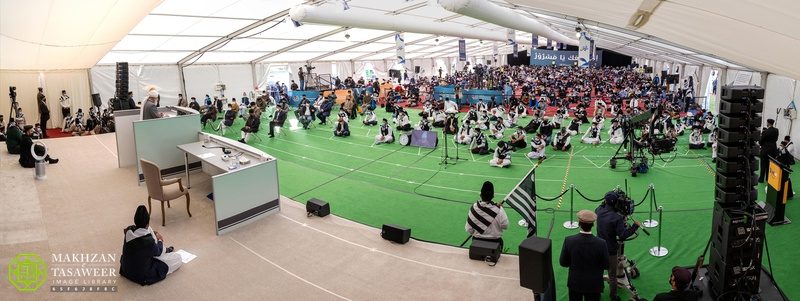
MKA UK National Ijtema, September 2021
“Nations cannot be reformed without the reformation of the youth.”
— Hazrat Musleh Mau’ud ra, slogan of Majlis Khuddamul Ahmadiyya
Huzooraba spoke of this slogan not as something to recite with pride, but as a personal wake-up call. Each Khadim must view these words as a challenge to themselves — to become an instrument of their nation's reformation by reforming themselves first. The Khuddam were in the prime of their lives, in health and mental capability. For the overall success of the Jama'at, they had to fulfil their role with the utmost conscientiousness.
He then spoke of three foundations upon which this reformation must rest: the regularity of prayer, offered with concentration and love; the daily recitation of the Qur'an, with understanding of its meanings; and above all, the virtue of truthfulness.
“Speaking the truth and acting with integrity is the means of gaining the nearness of Allah, whilst falsehood is equivalent to shirk—associating partners with God.”
— Hazrat Khalifatul Masih V aba, MKA UK National Ijtema, 2021
Falsehood, he said, was not a minor failing. It was a form of idolatry — a forsaking of trust in God. He reminded them of a Hadith: the one who is truly brave is not he who displays anger, but he who controls his temper. And another: on the Day of Judgement, Allah will shelter those who loved each other purely for His sake. This was the framework for true youth leadership — not rhetoric, but integrity; not proclamation, but quiet example.
He spoke also to those in education. Over 30% of the Khuddam were students. Alongside their prayers and religious development, they must excel in their studies — not for material gain alone, but so that when they entered their professions, they could reach the highest levels and become assets to both the nation and the Jama'at. He challenged the young men: the girls of the community were excelling them academically. Let there be a renewed commitment to academic excellence, so that a perpetual cycle of achievement would be established.
The Charge to Office Bearers
To the administration of Majlis Khuddamul Ahmadiyya, he gave a particular instruction: if all office bearers strive to personally improve and focus upon their spiritual development, this alone would have a profound effect on the entire Majlis. Even without special programmes, their personal example would become a means of guidance. Other Khuddam would see their sincerity and seek to emulate them.
The address closed with a prayer: that every Khadim would comprehend their immense responsibilities, fulfil their obligations to Allah and to His creation, and be those who illuminate the name of the Jama'at in the world. And that they would play a distinguished role in fulfilling the mission of the Promised Messiahas.
Source: Review of Religions, January 2022 · Address delivered 19 September 2021
Read the Full Address →19–21 May 2023
What Truly Distinguishes You
Frankfurt, Germany
In May 2023, Majlis Khuddam-ul-Ahmadiyya Germany held its second National Ijtema after the COVID-19 pandemic had eased. At Festplatz am Ratsweg in Frankfurt, Hazrat Khalifatul Masih Vaba sent a special video address to the gathered Khuddam. His message was not about the event itself, but about what an Ijtema truly is — and what it demands of those who attend.
"The primary goal of ijtemas," Huzooraba said, "is to ensure that our youth and children achieve moral, intellectual, and spiritual development." Not sports. Not routine. Not merely gathering together. The purpose is transformation — spiritual, intellectual, moral. Everything else serves that, or it serves nothing.
“There must exist a distinction between us and others. And what exactly is this distinction? It is the pursuit of attaining the pleasure of God Almighty.”
— Hazrat Khalifatul Masih V aba, MKA Germany Ijtema, 2023
He then spoke a truth that cut to the heart of what it means to be a Khadim. It is not excellence in sports, though that is good. It is not success in the world, though that is legitimate. What marks an Ahmadi youth is the pursuit of God's pleasure — every single action driven by that singular objective. He emphasised: "If we fail to do so, there will be no distinction between us [Ahmadis] and others."
Huzooraba spoke of the Promised Messiah'sas two great principles: first, the call to Tawhid — the Unity of Allah — and second, the cultivation of love and compassion. To fulfill the first, congregational prayer is essential. "The atmosphere of love and affection that truly defines the essence of a Jamaat" fulfills the second. Together, they form the foundation.
The Tasks He Set Before Them
Study the Holy Quran — not merely to recite it, but to understand its meanings, to read its translation and commentary, to grasp the profound truths contained within it through the writings of the Promised Messiahas.
Guard yourselves and your children from the negative influences of media, social media, and television. The world is full of distractions that pull the heart away from God. Pray for protection from bad company.
Parents: create a friendly, nurturing environment for your children. Teach them religious matters. Protect them from evil influences. By doing so, you fulfill your pledge of Bai'at and demonstrate loyalty to Khilafat.
Huzooraba spoke of the German Jamaat with particular praise. They possessed a profound bond with the Khalifat. When German Khuddam visited him, he observed a special connection. "May this spirit of sincerity and loyalty always remain," he prayed. But this was not flattery — it was a charge to continue, to hold fast, to let that bond deepen with each passing year.
The Ijtema was thus not an event to be enjoyed and forgotten, but a moment to renew the covenant — with God, with the Promised Messiah, with one another, and with the Khalifat. Each Khadim was leaving that gathering with a clear mandate: seek God's pleasure in every action. Let there be a visible distinction between you and the world.
Source: Al-Hakam, 20 May 2023
Read the Full Account →More chapters of this history are being added in the lead-up to Ijtema 2026.
88 Years On
The Northwest Region gathers in that same spirit — to reform, to unite, and to serve.
Join Ijtema 2026